
2022 Release Notes
New Features
Oil Cut Forecasting
Forecasting production for waterfloods or conventional reservoirs with drive mechanisms like bottomwater drive, edgewater drive, or combination drives can be complex. Value Navigator is unique among its peers in the way it integrates oil, total fluid, and now, oil cut forecasts for these reservoirs where production can be characterized by changing fluid composition. Building on existing 1 + WOR forecasting functionality, its reciprocal, oil cut, can now be forecasted with Arps parameters to define fluid composition relative to cumulative oil production. Oil cut offers a more intuitive fluid composition forecasting experience since it follows the same visual queue as normal Arps declines including a decline to the cumulative total on the X-axis on rate/cum graphs.
Base uses include pairing with an oil forecast to define the water production or with a max fluid rate to define the oil forecast. However, Val Nav enables you to go a few steps further. An oil + water forecast decline can also be generated to act as a variable maximum liquid rate, thus effectively modeling fluid handling constraints, while still honoring the supplied oil cut curve. Finally, all three curves can be supplied. By taking the lowest oil rate defined by either the oil curve or oil cut decline, Val Nav has the intelligence to determine whether the production bottleneck is reservoir capacity or an upstream limit like limited pump or pipeline capacity or choked back production.

Click image to expand or minimize.
Polygonal Map Selection
You now have more fidelity when selecting wells from the map with a new polygon selection mode. When enabled, a simple click-and-hold with the mouse enables you to draw lines while the "B" key creates a break in the line to draw a new polygon side. When finished, releasing the mouse sets the polygon and selects the wells inside.
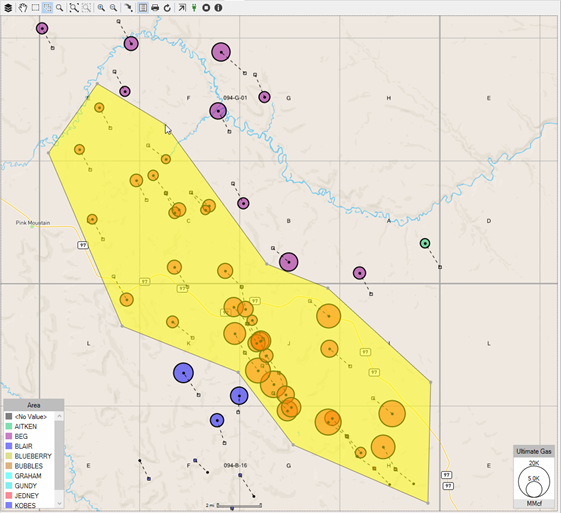
Click image to expand or minimize.
Enhancements
- Extended the Spreadsheet Import tool to import against Vendor IDs so that supplementary information from any data source can easily be appended with a simple import.
- Extended database connection functionality to utilize the SQL-recommended driver that supports TLS 1.1+.
- Extended product ratios auto-forecasting algorithm to Oil Cut. This adds yet another level of sophistication and efficiency to conventional reservoir and waterflood-based forecasting. These fits can be triggered in all the same ways as other products and ratios: * Alongside regular product fits via the fitting dialog (Predictions > Best Fit and Predictions > Refit) * Via graph interactions (alt-click, ctrl-click, etc., or via right-clicking) * On import of production data Fit options are available in the user options (Tools > Options > User Options).
- Extended allowable characters to support recommended naming in Azure SQL database deployments. Extended password limits to match the max allowable password length in the current database type.
- Extended database connection functionality to Azure SQL databases configured with integrated Active Directory.
- Broadened Val Nav workflow-oriented approaches to forecasting. Ratio constants can now be updated in bulk. Previously tied to production imports, these ratio updates can now be triggered by the user with a new Predictions dialog to rapidly update secondary product forecast projections with ease.
Bug Fixes
- Fixed an issue where long price deck names would not display correctly in Scenarios configuration dialog.
- Fixed an issue where floating point precision could cause a recently balance entity to remain very slightly unbalanced.
- Fixed an issue where imported Jurisdictions could create change records.
- Fixed an issue where imports of old User Options file could cause an error.
- Fixed an issue where imported Jurisdictions could remove the opening balance, posted date, and change records.
- Fixed an issue where map coloring would not render the first time the map was configured.
- Fixed an issue where certain Vendor IDs were incorrectly parsed when attempting to match to data sources.
- Fixed an issue where Condensate daily data was not properly aggregated when a Group was calculated.
- Fixed an issue with improper units displaying in the type well normalization field.